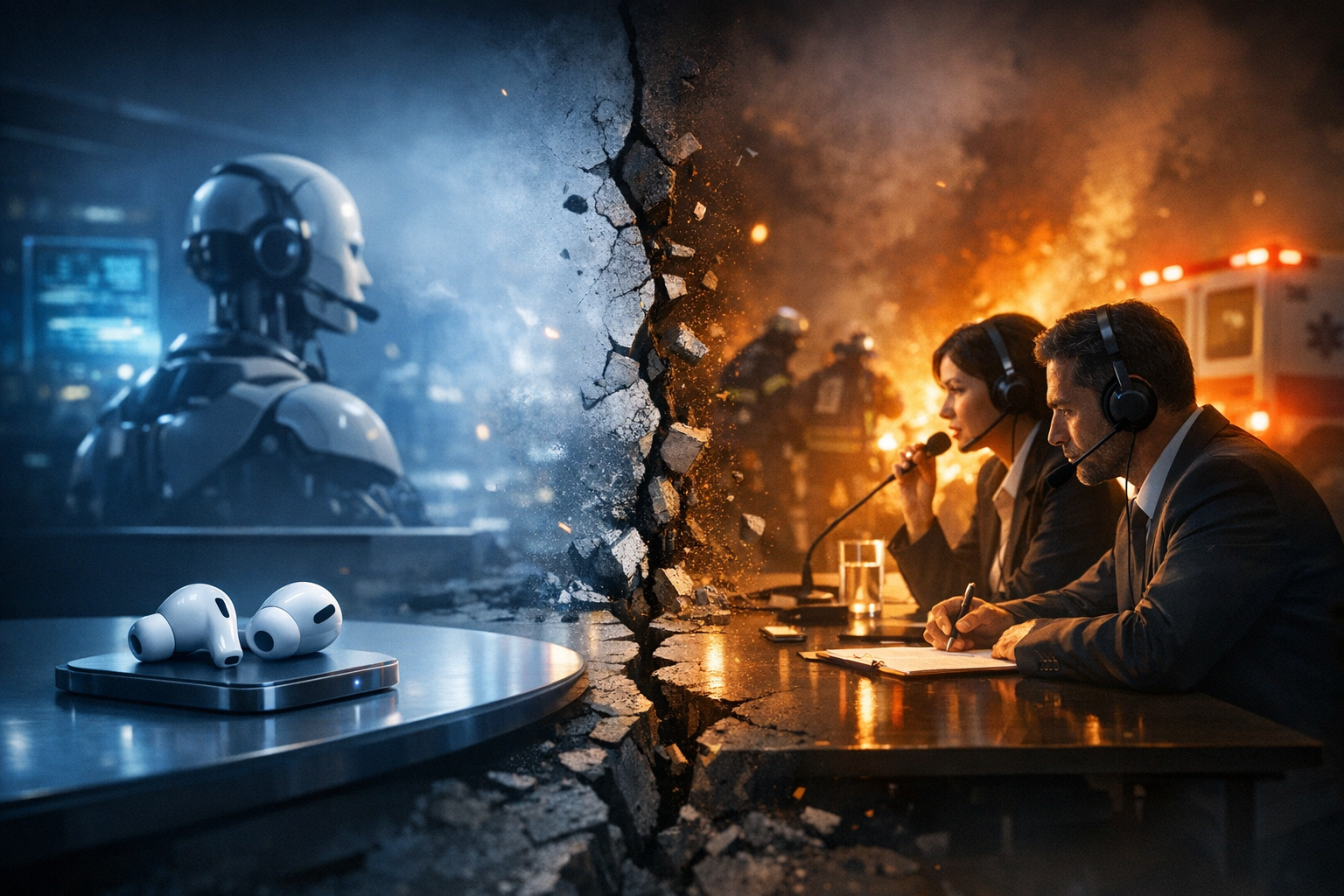
AI Earbuds vs Live Interpreters Who Wins in a Crisis?
- April 20, 2026
- text crisis communication , emergency translation
When global emergencies strike, clear communication can mean the difference between swift resolution and escalating chaos. From natural disasters and political unrest to medical emergencies abroad, organizations increasingly rely on technology and human expertise to bridge language gaps. But which solution truly performs when every second counts and misunderstanding is not an option?
1. Speed of Deployment: Who Connects First?
In a crisis, the first priority is getting communication tools up and running. AI-powered translation earbuds can be activated in seconds. Turn them on, connect to a device, and they are ready to process speech. For situations where responders arrive with limited preparation, this rapid deployment is a real advantage.
Live interpreters, however, require coordination, scheduling, and sometimes travel. That sounds like a disadvantage, yet many professional language service providers offer on-call emergency interpreters via phone or video, reducing wait times significantly. A specialized English to Turkish translation agency such as Orient Translation Services can quickly assign interpreters familiar with specific regions, dialects, and terminology, ensuring that once communication starts, it is highly accurate.
2. Accuracy Under Pressure
AI earbuds have made impressive progress in everyday scenarios such as tourism, basic customer support, or casual business meetings. They handle common phrases well and can manage predictable dialogues. However, in high-stress situations involving specialized terms, emotional nuance, or ambiguous speech, machine translation often struggles.
Live interpreters, especially those trained in emergency response, legal, or medical fields, do far more than convert words from one language to another. They interpret intent, clarify meaning, and resolve ambiguity on the spot. When a victim is panicked, crying, or speaking in fragments, a human interpreter can gently ask follow-up questions, confirm details, and provide a clear summary to responders. That level of adaptive understanding remains beyond current AI earbuds.
3. Handling Accents, Dialects, and Noisy Environments
Crisis zones are rarely quiet. Sirens, crowds, alarms, and overlapping conversations interfere with speech recognition. Although many AI earbuds include noise reduction and advanced models trained on diverse accents, they still have difficulty when the speech is distorted, shouted, or overlapping with background noise.
Human interpreters, by contrast, can infer meaning from partial phrases, tone, and context. They can move closer to the speaker, request repetition, or reframe questions until they obtain reliable information. They are also better equipped to handle regional dialects, slang, and code-switching. In environments where clarity is poor, human adaptability continues to outperform automated tools.
4. Emotional Intelligence and Cultural Sensitivity
Crisis communication is not just technical; it is deeply human. People experiencing trauma may be mistrustful, ashamed, or afraid. AI earbuds translate mechanically and cannot modulate tone, show empathy, or choose culturally sensitive phrasing. A literal translation delivered in a flat synthetic voice may come across as cold or even offensive.
Professional interpreters bring emotional intelligence into every interaction. They are trained to use respectful forms of address, acknowledge distress, and maintain confidentiality. They understand cultural taboos, local power dynamics, and what might be considered rude, threatening, or dismissive. In sensitive situations, such as medical consent, witness testimony, or negotiations, their ability to convey empathy and build rapport is essential to achieving cooperation.
5. Legal, Medical, and Ethical Risk Management
Many crises involve high stakes: signing legal documents, consenting to surgery, reporting abuse, or describing criminal acts. Errors here can trigger lawsuits, invalidate agreements, or endanger lives. Most AI translation tools come with disclaimers stating they are not suitable for critical decisions, and their output generally cannot serve as a legally reliable record.
Certified interpreters, on the other hand, follow professional codes of ethics and sometimes hold specific legal or medical certifications. Their work can be documented, verified, and, if necessary, defended in court. For hospitals, law enforcement, insurance companies, and international organizations, this accountability is crucial. Relying solely on AI earbuds in such scenarios exposes institutions to serious legal and ethical risks.
6. Scalability and Cost Considerations
AI earbuds appear cost-effective at first glance. Once purchased and set up, their marginal cost per conversation is low. Organizations dealing with frequent, low-risk multilingual interactions can benefit from this scalability. Customer information booths, preliminary triage in non-critical cases, or basic directions are examples where AI can reduce interpreter hours.
However, scaling human interpreting does not always mean flying people on site. Remote interpreting via phone or video, offered by many professional agencies, can be activated as needed, paying only for the time used. For complex or high-liability interactions, the higher per-hour cost of professional interpreters is offset by reduced risk, clearer decisions, and fewer misunderstandings that could become extremely expensive later.
7. Reliability When Systems Fail
Many AI earbuds rely on cloud-based processing. In a natural disaster or conflict zone, connectivity may be unstable or non-existent. Power outages, damaged networks, or cybersecurity threats can render connected translation devices unreliable at the exact moment they are needed most.
Human interpreters are more resilient in that sense. While they may also rely on communication technology to connect remotely, they are not dependent on constant high-speed data for every word processed. On-site interpreters function even in partial blackouts, provided basic conditions are met. For organizations planning for disaster resilience, building a network of trusted interpreters is still a core component of robust crisis communication planning.
8. Hybrid Strategies: Getting the Best of Both
The most effective crisis response strategies no longer pose AI and human interpreters as rivals. Instead, they combine both. AI earbuds can handle initial contact, simple questions, or low-risk information sharing, especially when human resources are limited or delayed. Once a situation is identified as sensitive, complex, or legally significant, professional interpreters can take over for detailed communication.
This hybrid approach optimizes cost, time, and safety. It allows emergency services, NGOs, and international companies to maintain continuous multilingual support while reserving human expertise for scenarios where nuance, precision, and empathy are indispensable.
Conclusion: Who Really Wins When It Matters Most?
AI earbuds are remarkable tools that continue to improve and play a growing role in multilingual crisis communication. They offer speed, scalability, and convenience, and they can serve as a valuable first line of support in many situations. Yet, when lives, rights, and long-term outcomes are on the line, professional human interpreters remain the more reliable choice.
Ultimately, the real winner is not a single technology or profession, but thoughtful planning: knowing when to rely on automated tools and when to bring in trained interpreters with sector-specific expertise. Organizations that treat language services as a strategic investment, rather than a last-minute add-on, are better equipped to protect people, make sound decisions, and uphold their legal and ethical responsibilities in any crisis.